Therapy for OCD and Intrusive Thoughts Using ERP
OCD therapy focuses on helping you break out of obsessive thought loops, compulsions, reassurance-seeking, and the constant need to feel certain.
Therapy is not about “getting rid" of thoughts. It’s about changing your relationship with them so they stop controlling your life.
What is OCD?
Obsessive-compulsive disorder (OCD) involves obsessions, compulsions, or both.
Obsessions are recurring thoughts, images, urges, or doubts that feel unwanted or distressing. They can show up around many themes, including harm, contamination, relationships, health, morality or religion, sexuality, responsibility, or things feeling “just right.”
Intrusive thoughts happen to many people. Having a disturbing thought does not mean you want it to happen or that it reflects who you are. With OCD, thoughts can become caught in a cycle of doubt, distress, and attempts to get certainty or relief.
Compulsions are actions or mental rituals someone feels driven to do in response to an obsession or a sense that something is wrong. They may briefly reduce distress, but the doubt often returns.
OCD can make ordinary uncertainty feel urgent and make it seem as though you need to think, check, avoid, or seek reassurance until you feel completely certain. The thoughts and rituals can take up a lot of time and make it hard to feel present in your own life.
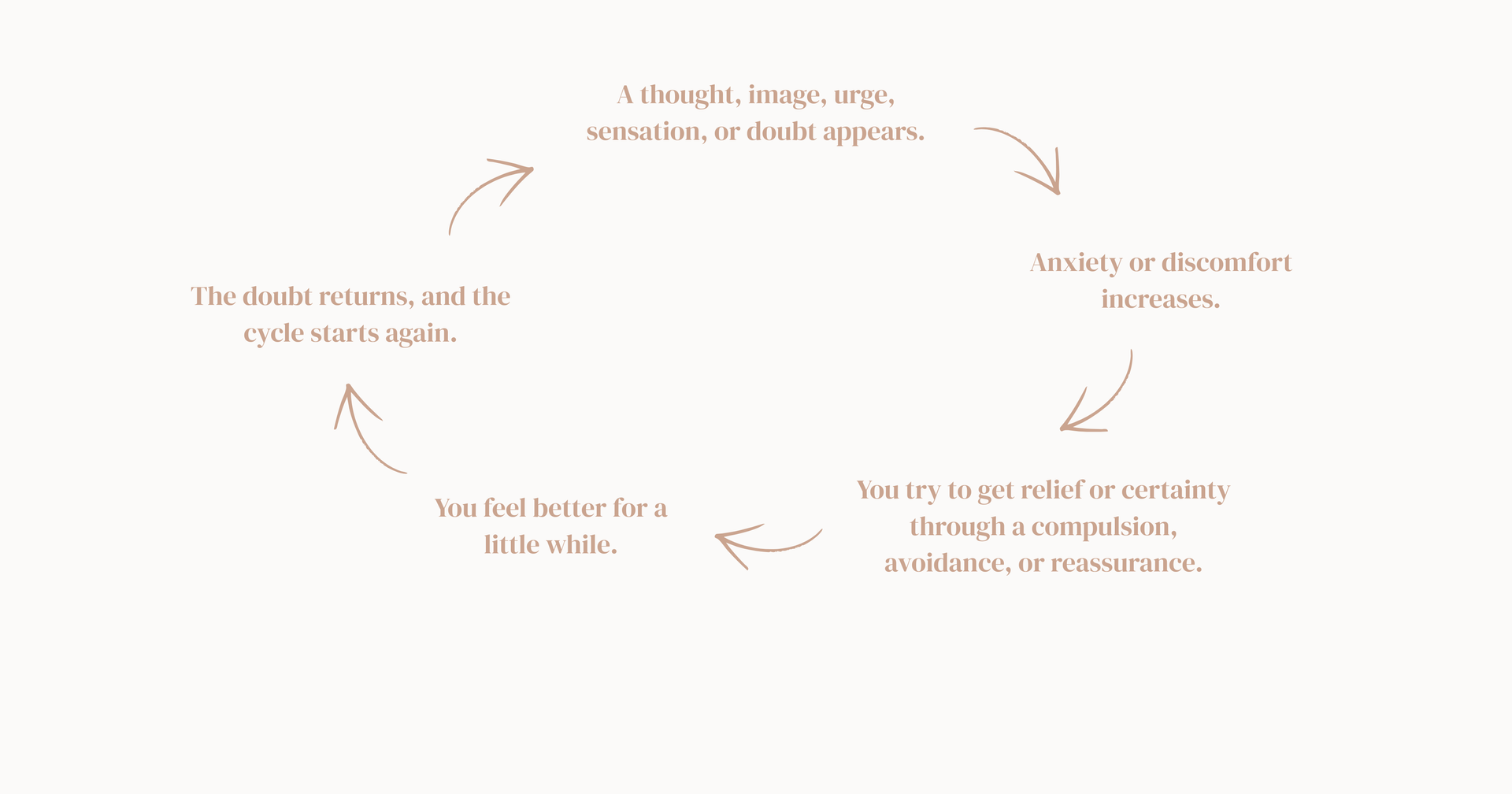
The OCD cycle can look like this:
Research shows it takes an average of 14-17 years for someone with OCD to get an accurate diagnosis and effective treatment for OCD...
Learn More About Finding The Right Therapist For OCD From The International OCD Foundation
What can OCD symptoms look like?
OCD can be difficult to recognize when rituals happen silently or when avoidance and reassurance-seeking have become part of daily routines.
Compulsions aren’t always visible. They may include:
- Checking, washing, repeating, arranging, or starting over
- Mentally reviewing events, analyzing thoughts, or trying to “figure out” what they mean
- Repeating phrases, counting, praying, or neutralizing thoughts in your mind
- Asking other people for reassurance or searching online for certainty
- Avoiding situations, people, objects, or information that trigger doubt
- Monitoring your feelings or reactions to determine what they “prove”
- Following rigid rules to prevent a feared outcome or make something feel complete
My approach to OCD treatment
ERP is the gold-standard treatment for OCD, and I am actively working towards an independent certification in Exposure and Response Prevention. ERP is the foundation of my OCD treatment. We identify the obsessions, compulsions, avoidance, and reassurance-seeking that keep the cycle going, then gradually practice responding differently.
I may also use alternative or second-line approaches in addition to ERP, like CBT, psychoeducation, and DBT skills, to support the work. IFS-informed parts work can help us approach the protective intentions behind OCD patterns with curiosity, while continuing to change the compulsions that keep the cycle going. If distressing past experiences are also part of what you’re working through, we can discuss whether EMDR may be appropriate alongside OCD-focused treatment.
What ERP actually looks like
We map your OCD cycle.
We identify the thoughts, images, urges, or situations that trigger distress, along with the compulsions that follow.
We look for less visible responses too, like mentally reviewing, checking how you feel, avoiding triggers, or asking for reassurance.
We choose a place to begin.
Together, we make a plan for practicing with OCD triggers. We start with steps that feel challenging but workable, then build from there. You’ll also identify the ritual, avoidance, or reassurance response you want to practice changing.
You practice facing a trigger.
An exposure might involve touching an object, leaving something unchecked, having an uncertain thought without solving it, or entering a situation OCD tells you to avoid. The practice is tailored to your OCD; it isn’t about choosing a random fear or proving that nothing bad can happen.
You practice response prevention.
As you face the trigger, you work on not doing the compulsion, mental ritual, avoidance, or reassurance-seeking that OCD is asking for. We’ll talk through what feels difficult and adjust the plan collaboratively.
Common questions about therapy
How do I know if therapy is right for me?
You do not need to be in crisis for therapy to be helpful. Many people start therapy because they feel overwhelmed, stuck, anxious, emotionally exhausted, disconnected from themselves, or tired of repeating the same patterns. Therapy can provide support, insight, and practical tools to help life feel more manageable.
What can I expect during the first session?
The first session is focused on getting to know you, understanding what has been going on, and discussing what you hope to get out of therapy. We will also talk about your history, current concerns, and goals for treatment. There is no pressure to share everything immediately; therapy is a process, and we move at a pace that feels comfortable.
How often will we meet?
Most clients begin with weekly sessions to build consistency and momentum in therapy. Depending on your needs and goals, sessions may later become biweekly or adjusted over time.
How long does therapy take?
There is no “right” timeline for therapy. Some people benefit from shorter-term support focused on specific concerns, while others prefer longer-term therapy for deeper emotional work and ongoing growth. The length of therapy depends on your goals, symptoms, and what feels most helpful for you.
What types of therapy do you use?
I use evidence-based approaches, including EMDR, ERP, IFS, ACT, CBT, and DBT. Therapy is individualized, meaning we will work together to find the approach that best fits your needs and goals.
Do I need to know exactly what’s wrong before starting therapy?
Not at all. Many people come to therapy knowing they are struggling but not fully understanding why. Part of the process is helping you better understand your emotions, patterns, stressors, and experiences in a supportive and collaborative way.
What if I have trouble opening up?
That is completely okay. Many people feel nervous starting therapy or struggle with vulnerability, especially if they are used to handling things on their own. Building trust takes time, and there is no expectation to immediately share everything all at once.
Is therapy confidential?
Yes. Therapy is confidential, meaning what you share in sessions stays private except in specific situations required by law, such as safety concerns involving harm to yourself or others, abuse, or court-related requirements. Confidentiality and its limits will be reviewed during the intake process.
Do you offer virtual therapy?
Yes. I provide virtual therapy for clients located in North and South Carolina, as well as in-person sessions in SouthPark Charlotte, NC.
Do you accept insurance?
I currently accept Aetna and Blue Cross Blue Shield. I can also provide superbills for out-of-network reimbursement depending on your insurance plan.